

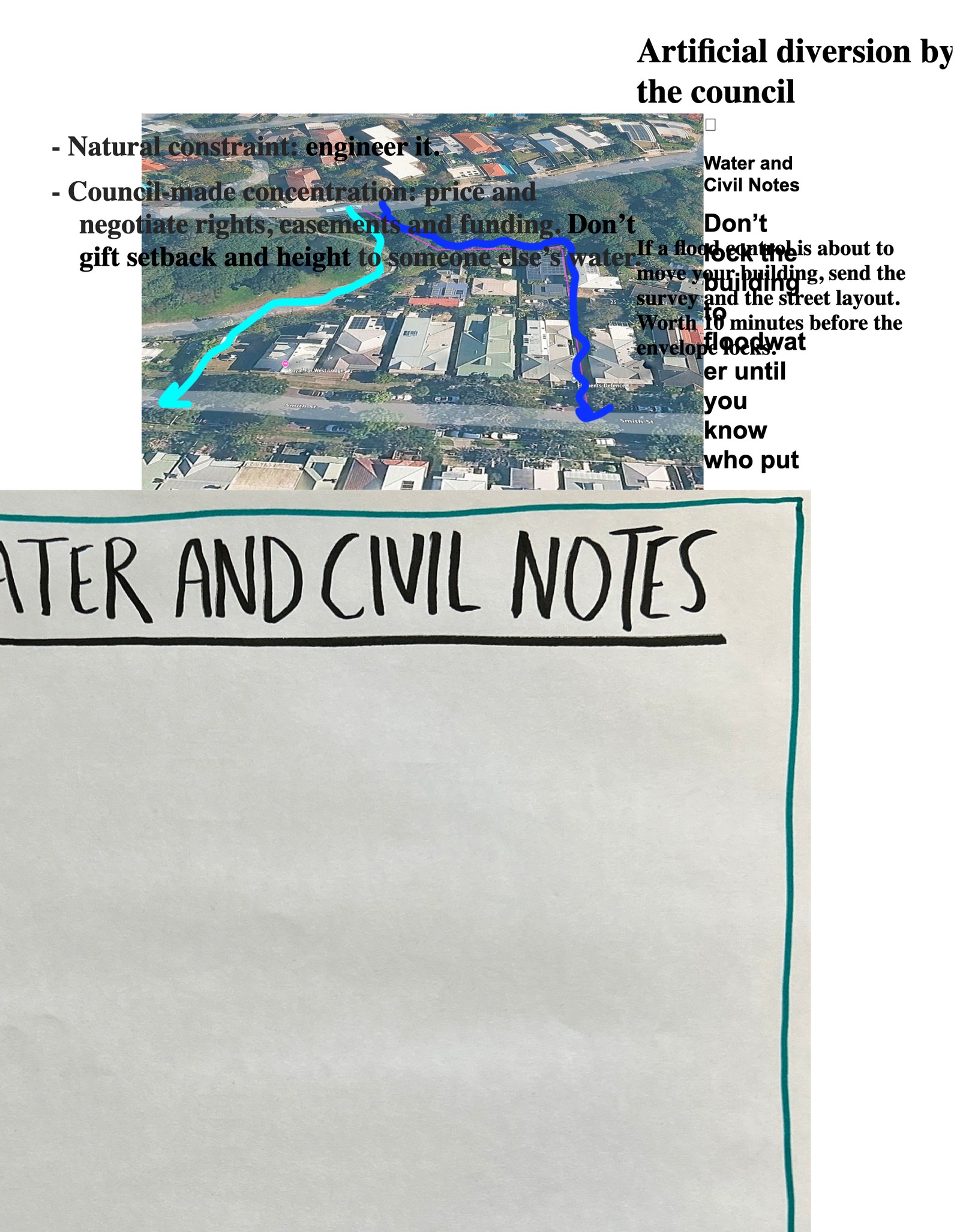
Natural flow ≠ council-concentrated road flow.
Council marks a flood path across the plan. The easy move is to pull the building back, lift the floor, or lose a storey.
Before you freeze that envelope, ask a simpler question: whose water is it?
Two different problems
Some sites just sit in the natural drainage line. The water would be there with or without the street. That is a design problem: freeboard, conveyance, safe access, maybe flow under the building. NSW’s Flood Risk Management Manual 2023 still expects you to understand hazard, function and residual risk on those sites. You engineer the form to the water.
Other sites are getting road and pipe water concentrated onto the lot. A pit in the street. A pipe that ends on your land. A surcharge that only exists because the network dumps there. That is a different problem. Rights, easements, and who pays sit next to the hydrology.
Mix the two up and you redesign the architecture for a load council created, and often never put on title.
Natural drainage still has rules
Higher land has long had a natural right to drain onto lower land. The High Court in Gartner v Kidman (1962) is the classic statement: natural overland flow is part of how land works.
Development changes the bargain. Cover the site in roofs and paving and you can send more water than nature ever put there. Corbett v Pallas (1993) is the usual NSW warning: the increase is what triggers nuisance liability. That is why detention and “no increase in peak discharge” designs matter when you drain toward a neighbour, and why draining away from the street without an easement is sometimes available when you can prove the burden does not rise.
Natural flow is not a free-for-all. It is still a civil design job. It is just not the same job as fixing someone else’s pipe.
When the water is council-made
Once the flow is artificial, the frame shifts. If a public authority wants a lasting right through private land for a pipe or drain, the title system expects that interest registered. Unless it is on title, it does not bind the world as an interest in land. A pipe without an easement is not a free right to sterilise the building envelope forever.
In practice that shows up as DA conditions: move our pipe at your cost, grant a free easement, keep a multi-metre dry strip beyond anything paid for on title. Sometimes the engineering is real. Sometimes the condition is policy dressed up as physics.
There is case texture for pushing back. In the Burwood dual-occupancy fight planning lawyers still cite, the demand that owners relocate a council stormwater main and hand over an easement for nothing was treated as unreasonable in the extreme. At Warriewood, artificially terminating a large upstream catchment pipe onto private land without rights was fought as nuisance; the practical end state was extending the line. Colonial Credits Pty Ltd v Pittwater Council (LEC 10667 of 2015) ran the commercial cousin: when you build drainage and wear an easement for upstream water council historically directed onto the land, contributions should reflect the cost of works and the value hit of the easement.
None of that means every wet mark is a lawsuit. It means you separate natural constraint from artificial load before you freeze height and setback.
Quick test before the envelope locks
- Would this path exist if the street network were not there?
- Is there a pipe or pit directing flow onto the lot?
- Is any of that protected by a registered easement, and how wide was the easement actually paid for?
If the answer is natural valley water, engineer it. Freeboard, conveyance, elevated form, emergency access. The recent Box Road industrial community-title consent in Mount Street 1 Pty Ltd v Sutherland Shire Council [2026] NSWLEC 1666 shows the pattern when conveyance is upgraded and buildings sit above the path with flow underneath: hydraulics first, then residual emergency management.
If the answer is council-concentrated road or pipe water, price and negotiate rights, relocation, offsets and who pays. Do not gift setback and height to someone else’s water.
Architects: do not lock the grid to a flood hatch until the civil story says whose hatch it is.
Developers: put the title search, deposited plan and a street-view pit check next to the concept massing. The five-second kerb-inlet check is still a useful first screen for hidden council drainage.
Natural constraint: engineer it.
Council-made concentration: negotiate it.
If a flood mark is about to move your building, send the survey and the street layout. Worth ten minutes before the envelope locks.
ian.warren@stellenconsulting.com.au